Solar Power as an
Alternative to
Petroleum
Chemistry 405 Paper
Spring 2001
Christine J. Benson
With the ever-growing price of gas and warnings of the diminishing supply of oil on earth, we should be thinking about what we are going to do when we run out of this precious resource.
Threats of $3.00 per gallon gas prices this summer perhaps should get us thinking about alternatives. I personally would love to see the world lose all dependence on oil, and watch all the companies that have been trying to bleed us dry over the years go completely out of business. I understand that this would really cause a lot of people great hardship, but according to estimates the world’s oil supply is going to be gone in 40 years anyway. I don’t think that it would be wise for us to wait until the last minute, until every ounce of oil has been sucked from our reserves.
We have become so dependant on petroleum that the major oil bearing countries have huge controls over us. More than once over the past year or so I have heard people talk about our president going overseas to negotiate for lower oil prices.
In addition to the ridiculously high costs of buying petroleum, we must also take into account the other costs of petroleum, the environmental and health costs. Petroleum is responsible for up to $267 billion in environmental damages. These damages are due to global warming in addition to groundwater, soil and air pollution. Unfortunately these costs can’t be expressed entirely by a money figure. We can talk about the costs of cleaning up an oil spill, but how do you put a price on the lives of aquatic animals? How do you express the cost of losing the ozone layer? We can’t go buy a new one! We are paying huge prices for petroleum products only to pay more in taxes for the damages that were sustained in order to bring them to us. (For more information on this see http://www.ilsr.org/carbo/costs/truecosts3.html)
Combustion of fossil fuels is responsible for 98% of the US carbon dioxide emissions. Carbon dioxide is an invisible gas that accounts for about two-thirds of all heat trapped by greenhouse gases. These gases threaten human health by increasing the spread of diseases like malaria, yellow fever, and cholera.
In the US power plants are responsible for 70% of sulfur dioxide emissions, 33% of all nitrogen oxide emissions, 32% of particulate matter emissions, 23% of mercury emissions, and 36% of the carbon dioxide emissions.
Let’s take a minute to analyze the previous paragraph. We’ve already discussed the effects of carbon dioxide. Sulfur dioxide is the primary precursor to acid rain. SO2 emissions react in the atmosphere to form tiny acidic particles, which can cause many serious adverse impacts such as breathing constriction and visibility impairment. The acidic particles washed out of the air by rain have acidified over 1,000 large lakes and thousands of streams in the US.
Nitrogen Oxide gases can result in numerous health impacts such as decreased pulmonary function, lung inflammations, immune system changes, and eye irritation. It is also a contributing factor to acid rain.
Next on the list of pollutants are particulates, also known as soot or smoke. These fine particles evade the body's natural defenses and lodge themselves deep in the lungs. This produces an array of serious health impacts, including reductions in lung capacity, aggravation of pre-existing respiratory ailments, cancer and even death. Studies have shown that lives are shortened by one to two years in the more polluted areas. Particulates have been linked to hospitalizations for heart attacks, angina and heart failure. Researchers estimate that almost 1,200 heart disease hospital admissions in Detroit each year can be attributed to particulate matter pollution.
As for mercury, it along with lead, arsenic and other hazardous materials, are associated with causing cancer, brain damage, reproductive disorders, birth defects and in extreme cases even death. They also contribute to the contamination of water bodies and then find their way into animals and plants that humans consume.
Now that we have become familiar with some of the problems that are caused in some way by fossil fuels, we can look at some energy alternatives. Some energy alternatives are solar, wind, nuclear, and geothermal energy. Considering the mass amounts of information solar power will be the only one of these to be discussed here.
Enough energy reaches the earth’s surface each year to produce 1,000 times the energy that would be produced by burning all the fossil fuels that were mined and extracted in the same period of time. Solar energy is clean, healthy and readily available because it doesn’t need to be explored, mined, extracted, transported, combusted, transmitted or imported (For more information on pollution see http://www.solarenergy.com/info_clean_healthy.html)
Solar thermal electric power plants use lenses and reflectors to concentrate the suns energy and generate heat. This heat can be stored so the plant is able to generate heat at any time (including during the night and when it rains). These plants meet the needs of over 350,000 people thereby displacing 2.3 million barrels of oil annually.
It is expected that over 700 megawatts of solar thermal electric systems will be deployed by the year 2003, and that the market for these systems will exceed 5,000 megawatts by the year 2010. The 5,000 megawatts is enough energy to meet the residential needs of over 7 million people, displacing 46 million barrels of oil per year.
Solar thermal electric power plants produce 2 ½ times as many skilled high paying jobs as conventional fossil fuel plants. Currently the solar energy provided by these plants is more costly than that of fossil fuel plants, however the solar plants are paying almost twice as much in taxes as the fossil fuel plants. If the taxes were the same for both, the prices of the two types of energy production would be about the same.
Using only 1% of the earth’s deserts to provide solar electric energy would produce more electricity than is being produced in the entire world by fossil fuels.
There are three ways that solar thermal energy is collected, solar parabolic troughs, solar parabolic dishes, and power towers.
Solar parabolic troughs consist of curved mirrors that form troughs that focus the sun’s energy directly on a pipe. A fluid is circulated through the pipes and is used to drive a generator to produce electricity.
A solar parabolic dish consists of a concentrator that has a parabolic shape like that of a satellite dish. The concentrator reflects solar radiation onto a receiver that is mounted at the focal point of the dish. There is a heat engine mounted at the focal point that uses the collected heat to produce electricity.
Power Towers, also known as solar central receivers, are towers that are surrounded by a vast number of heliostats. Heliostats are mirrors that track the sun and reflect its rays into a receiver that absorbs the energy and uses it to drive a turbine electric generator (for pictures of the different solar thermal electric systems see http://www.solarenergy.com/info_making_electricity.html).
The above three methods of converting solar energy to heat or chemical energy are indirect methods of doing it, however the most common form of solar cells are Photovoltaic (PV) cells. These cells are very appealing because they have no moving parts, need little maintenance, are environmentally safe, and are fairly simply designed. They just produce electricity whenever they are exposed to light. Over the last few years the government has allotted a great deal of the solar energy research budget to PV projects (for more information concerning PV cells see http://www.solarenergy.com/info_photovoltaics.html).
PV cells consist of a two-layer semi conductor device that produces a photo voltage or potential difference between the layers.
Silicon solar cells are produced in three ways. The first is the production of single crystal wafers. Single crystal wafers are made by slicing them from a large crystal ingot, which is grown by a very expensive process involving 1400º C temperatures. In this process the silicon must be highly pure and have a nearly perfect crystalline structure.
Production of polycrystalline wafers is the next type of the three different processes. These wafers are made by a casting process where molten silicon is poured into a mould and allowed to set. The mould is then sliced into layers. This process is much more inexpensive because the constant 1400º C temperatures are not required, however they are not as efficient as the former due to imperfections in the structure resulting from the casting process.
In the previous two production methods almost half of the silicon is lost as saw dust. This brings us to thin film technologies. There are several ways in which this method is used. Amorphous silicon is one of these technologies. These are made by depositing silicon onto a glass substrate by using a gas such as silane.
In solar cell production dopant atoms of silicon are introduced to create p-type (positive) and n-type (negative) regions to produce a p-n junction. The doping of these layers can be done at high temperatures in a furnace where the dopant is introduced as vapor.
Silicon has 4 loosely held valence electrons for bonding with nearby atoms. By replacing one of the silicons in the crystalline structure with an atom with either 3 or 5 valence electrons a space will be produced with no electron (a hole) or a spare electron that is more mobile than the rest. The creation of excess holes is referred to as p-type doping, and the creation of extra electrons is referred to as n-type doping. Boron is most often used to make holes and phosphorus is most often used to create extra electrons.
After the p-n junctions are created, electrical contacts are made by evaporating or screen-printing metal onto the wafer. The back of the wafer can be covered entirely by the metal but the metal can only be put on the front of the wafer in a grid otherwise the metal would block the sun’s light from reaching the wafer.
Let’s consider that solar cells are composed of two types of material, the p-type silicon, and the n-type silicon. Certain wavelengths of light are able to ionize some of the atoms in the silicon therefore making the internal field separate some of the positive charges from the negative charges. The holes are swept into the p-layer and the electrons are swept into the n-layer. Although the charges are attracted to one another some of them can only recombine by passing through an external circuit because of the internal potential energy barrier. If the circuit is made power can be produced by the cells under illumination, because the free electrons have to pass through the load in order to recombine with the positive holes. For a good representation of how solar cells work see the picture below. This picture was found at http://acre.murdoch.edu.au/refiles/pv/text.html.
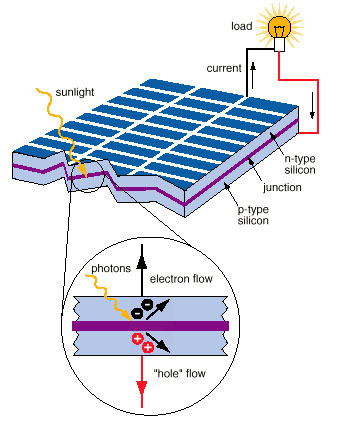
For more information concerning how PV cells work please refer to http://acre.murdoch.edu.au/refiles/pv/text.html.
You may be wondering how a solar electric energy system would work in a home. You may have some concerns about how reliable a system like this is. The standards for the manufacture of PV’s are high enough to ensure a life of 25 years. They are generally laminated between specially toughened high transparency glass and an impenetrable back sheet of plastic to ensure that no moisture can get in and cause corrosion. All manufacturers of PV panels are now confident enough to offer a ten-year performance warranty.
As far as how it all works together, PV’s are put together in a couple of ways. They are installed in arrays and systems. Generally if more power is required than can be supplied by one panel, a number of panels can be linked together to meet the demand. However a problem sometimes arises where power is required in greater quantities and voltages than can be provided by the panels themselves. In these cases PV systems are used.
The picture below was found at http://acre.murdoch.edu.au/refiles/pv/text.html.
(a) A PV panel array, ranging from two to
many hundreds of panels;
(b) a control panel, to regulate the power from the panels;
(c) a power storage system, generally comprising of a number of specially
designed batteries;
(d) an inverter, for converting the DC to AC power (eg 240 V AC)
(e) backup power supplies such as diesel startup generators (optional)
- framework and housing for the system
- trackers and sensors (optional);
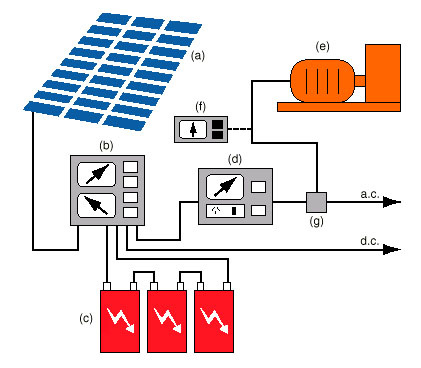
Figure 5 Elements of a PV System
This picture is a good illustration of the parts of a PV system and how they all fit together.
An array consists of panels run in a series or parallel to one another. In an array the voltage output is limited to between 12 and 50 volts but have higher current. More and more arrays of panels are being used in building construction where they serve two purposes: (1) to act as a wall or roof, and (2) to provide electricity. Eventually when the prices of solar cells fall we see more building integrated solar cells being used as a major source of electric power.
The price of solar panels has dropped drastically over the past 8 years, going from $8-10 per Watt to $3-6 per Watt. This is still pretty high considering that a 50 Watt panel would cost somewhere around $200 (To read more about solar panels see http://acre.murdoch.edu.au/refiles/pv/text.html).
A business can save between 40-80% on electric or fuel bills by replacing its conventional water heating system with a solar hot water heating system.
Some examples of “solar systems” in action will be discussed in the following section.
In 1996 for the Summer Olympics in Atlanta Georgia a solar pool heating system of over 10,000 ft2 was installed. It maintained the pools temperature within 1º. Estimates are that this pool heating system will save over $12,000 annually in heating costs.
Gould Electronics, Inc. in Chandler AZ meets 60% of it’s yearly water heating needs for its copper foil manufacturing facility by utilizing a parabolic trough solar collector. The system was installed in 1982 and has proven a 90% availability rate and a monthly savings of $7,500.
In Fairfield, CA a PV manufacturing company makes use of thin film PV modules that transmit light. This makes them useful in building facades. The PV modules can be used as skylights and awnings therefore fitting in with the overall construction of the building. Not only do they generate electricity and lower the cost of construction, but they also contribute to the aesthetics of the building.
The most popular tourist destinations are also the places that benefit the most economically and environmentally from clean, quiet solar energy. The average hotel, operating year-round and having an occupancy rate of 100% for four months and 40% for the remaining months with a 15-cents/kWh cost of electricity, has an annual electric hot water cost of $2,220. The cost of installing a solar hot water system to meet that same demand can be as low as $6,000. With more than $2,000 savings per year the payback time for the solar system is less than three years. After that it’s all money in their pocket (For more cases of solar energy utilization see http://www.solarenergy.com/info_taking_care_business.html).
Solar rays provide a clean, quiet and abundant source of energy that may take the place of fossil fuels in the near future. Although prices of solar energy systems are fairly high it will pay for itself many times over during its lifetime. Considering the benefits in comparison to fossil fuel energy, it’s a wonder why solar power hasn’t entirely taken the place of petroleum in providing electricity and heat for homes and businesses.
Bibliography
Carr, Anna, Serena Fletcher, Katrina O’Mara, and Mark Rayner. June 1999. Solar Cell Principles – web document. http://acre.murdoch.edu.au/refiles/pv/text.html
Solarenergy.com. 1997. Taking Care of Business – web document. http://www.solarenergy.com/info_taking_care_business.html
Solarenergy.com. 1997. Solar: Clean and Healthy Energy – web document http://www.solarenergy.com/info_clean_healthy.html
Solarenergy.com. 1997. Photovoltaics –web document http://www.solarenergy.com/info_photovoltaics.html
Solarenergy.com. 1997. Solar: Solar Thermal: Making Electricity From the Sun’s Heat – web document. http://www.solarenergy.com/info_making_electricity.html
Institute for Local Self-Reliance. 1996. Oil Slickers: How Petroleum Benefits at the Taxpayer’s Expense – web document. http://www.ilsr.org/carbo/costs/truecosts3.html